

Stop 2: French Drain
Overview
Quick Facts
Photo Gallery


The Problem
Many residential and commercial landscapes have areas where water collects after rain events: soggy patches in the lawn, puddles near walkways, or persistent dampness near foundations. Surface grading alone cannot always solve these problems, especially where subsurface water movement contributes to the issue.
The Solution
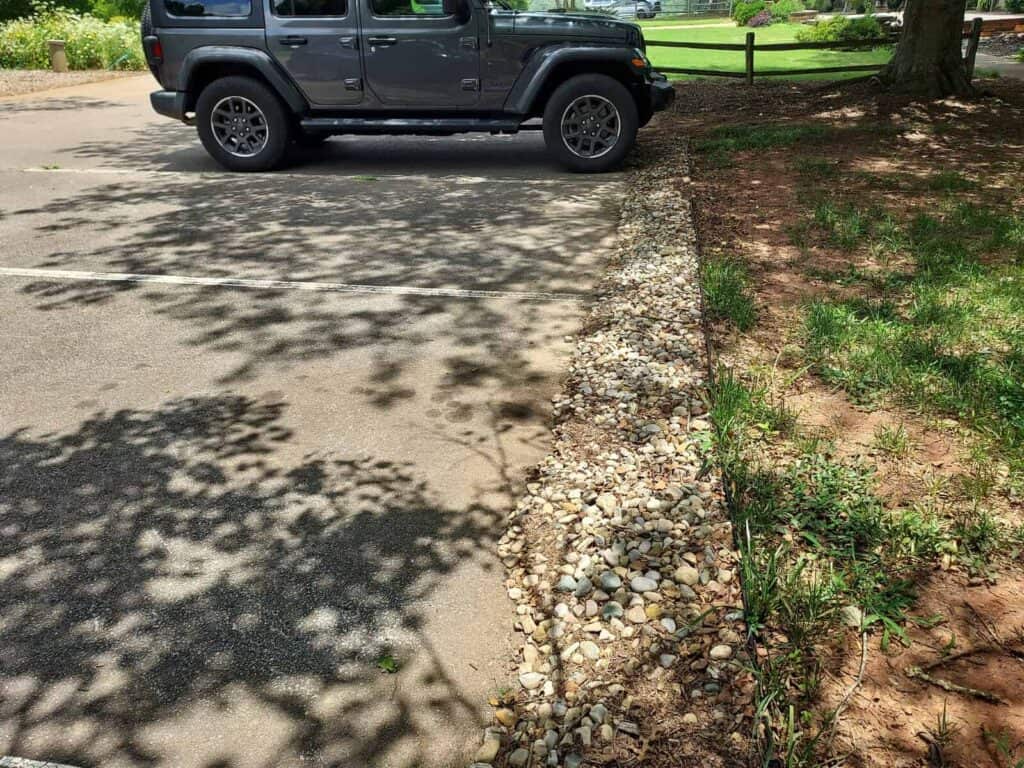
French drains work below the surface to intercept water before it causes visible problems. By creating a preferential flow path using gravel and perforated pipe, the system draws water away from saturated areas and redirects it to an appropriate discharge location. At the demonstration site, the French drain collects subsurface outflow from the pervious paver area and channels it toward the bioswale.
How It Works
Water enters the trench through the surrounding soil and the gravel fill at the surface. It flows through the gravel into the perforated pipe, which carries it by gravity to the discharge point. The geotextile fabric lining prevents soil from migrating into the gravel and clogging the system, while the stone provides structural support and additional water storage capacity.
Design Specifications
Trench Construction
- Trench: 18 inches deep by 18 inches wide
- 4-inch drainage pipe perforated on the underside only
- Nonwoven geotextile fabric lining the trench and encasing the pipe
- No. 2 stone encasing the pipe within the geotextile fabric
- Pipe positioned 3 inches above the trench bottom
- Top 3 inches filled with No. 4 river gravel for finished surface appearance
- Lawn edging at 4 3/4 inches deep to contain gravel
Slope and Grading
The trench and pipe must slope consistently toward the discharge point. A minimum slope of 1% (approximately 1/8 inch per foot) is recommended.
Try It Yourself
French drains are one of the most versatile residential stormwater solutions. Common applications include directing downspout runoff away from foundations, draining soggy lawn areas, intercepting slope runoff before it reaches patios or walkways, and connecting multiple stormwater practices. Most homeowners with basic excavation skills can install a French drain as a weekend project.
For Professionals
French drains are addressed in the Georgia Stormwater Management Manual as a conveyance practice that can be integrated with other stormwater controls. For compliance applications, consult the manual for sizing requirements and discharge specifications.
A French drain should drop at least 1 percent in depth for every 100 feet of length (or 1/8 inch per foot) to deliver collected stormwater to another control measure or drainage area in the lawn. The maximum slope recommended for a French drain installation site is 6%, and if it is any steeper, the flow from the drain pipe could cause erosion upon exit or back up at the exit.
A small French drain with a 4-inch pipe, a 1% slope, and a 12 inch × 12 inch gravel trench can handle approximately 5 GPM or 300 gallons per hour. For reference, an 800 square foot roof surface will produce about 500 gallons of rainwater under a 1-inch rainfall. Depending on the rainfall rate, a larger pipe and trench size might be necessary.
Resources
Download fact sheets, design guides, and technical resources for this practice.
-
French Drain Installation Guide Coming Soon
-
Subsurface Drainage Design Specifications Coming Soon
- Georgia Stormwater Management Manual
- NRCS Subsurface Drain Conservation Practice Standard