

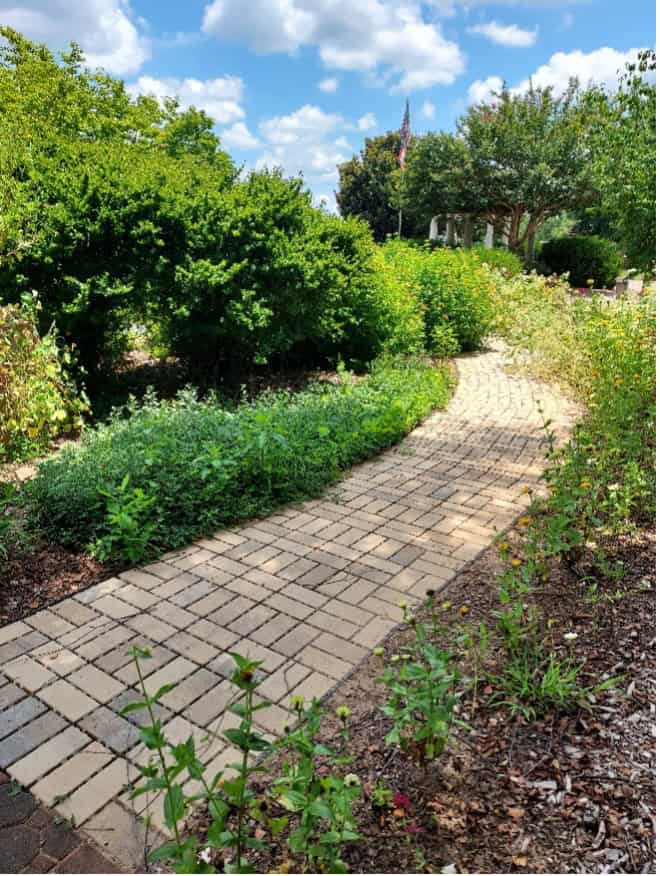
Stop 5: Pervious Paver Block
Overview
Quick Facts
Photo Gallery


The Problem
Traditional paved surfaces (concrete sidewalks, asphalt driveways, and conventional patios) are completely impervious. Rain that falls on them becomes runoff, carrying pollutants and contributing to downstream flooding and erosion. In developed landscapes, these surfaces often make up much of a site’s impervious area.
The Solution
Pervious paver blocks help reduce stormwater flooding in landscapes, city streets, and parking areas. They are more durable than grass or gravel pervious plastic grid systems and give a more finished look, closer to conventional brick or stone paving. Pervious paver systems are useful stormwater control measures for highly developed landscapes lacking open space for detention ponds and other drainage structures.
How It Works
Permeable interlocking paver blocks consist of manufactured concrete units that leave small openings between joints. These joints are filled with small stone aggregates (about 1/8 to 1/4 inch) that allow water to pass through the spaces and into larger angular stone reservoir layers beneath. During and after rain events, stormwater infiltrates the soil below the stone layers.
Design Specifications
System Layers (Top to Bottom)
- Pervious concrete paver blocks with aggregate-filled joints
- Bedding layer of small angular aggregate (1/8 to 1/4 inch)
- Base layer of No. 57 stone (6 inches)
- Sub-base layer of No. 2 stone (6 inches)
- Geotextile fabric at subgrade interface
- Prepared subgrade with minimum 0.5 in/hr infiltration rate
The subgrade slope should be 0.5% or less. Greater slopes allow water to run along the bottom rather than infiltrating evenly.
Try It Yourself
Pervious pavers are an excellent choice for homeowner driveways, patios, and walkways where a more finished, durable surface is desired compared to gravel or grass grid options. They offer the aesthetic appeal of traditional brick or stone pavers while providing significant stormwater benefits. Professional installation is recommended for vehicular areas.
For Professionals
Pervious paver systems are well-documented in the Georgia Stormwater Management Manual for compliance applications. For design specifications covering vehicular loads, traffic patterns, and ADA compliance, consult the Interlocking Concrete Pavement Institute (ICPI) guidelines and local stormwater ordinances.
When constructing pervious paver block sidewalks, the Americans with Disabilities Act (ADA) requirements should be met for public right-of-way passages or in places of public accommodation, such as a doctor’s office or day care center. The ADA does not cover strictly residential private apartments and homes. The optimal opening size for permeable joint aggregates of the pervious paver system is 3/8 inch (10 mm), which is below the ADA opening threshold of 1/2 inch, and is ADA compliant.
Resources
Download fact sheets, design guides, and technical resources for this practice.
-
Permeable Paver Systems Fact Sheet Coming Soon
-
Pervious Pavement Design Specifications Coming Soon
- ICPI Permeable Interlocking Concrete Pavement
- Georgia Stormwater Management Manual