

Stop 4: Rain Barrels
Overview
Quick Facts
Photo Gallery
The Problem
A typical residential roof can generate hundreds of gallons of stormwater during a single rain event. When that water flows unchecked from downspouts onto the landscape, it can erode soil, flood planting beds, and contribute pollutant-laden runoff to local waterways. Most homeowners have no system in place to capture this water before it becomes a problem.
The Solution
Rain barrels intercept downspout flow and store it for later use. Even a single 40-gallon barrel captures roughly a third of the runoff from a typical 200-square-foot roof section during a 1-inch rain event. The stored water can then be used for garden irrigation, reducing both stormwater volume and municipal water consumption.
How It Works
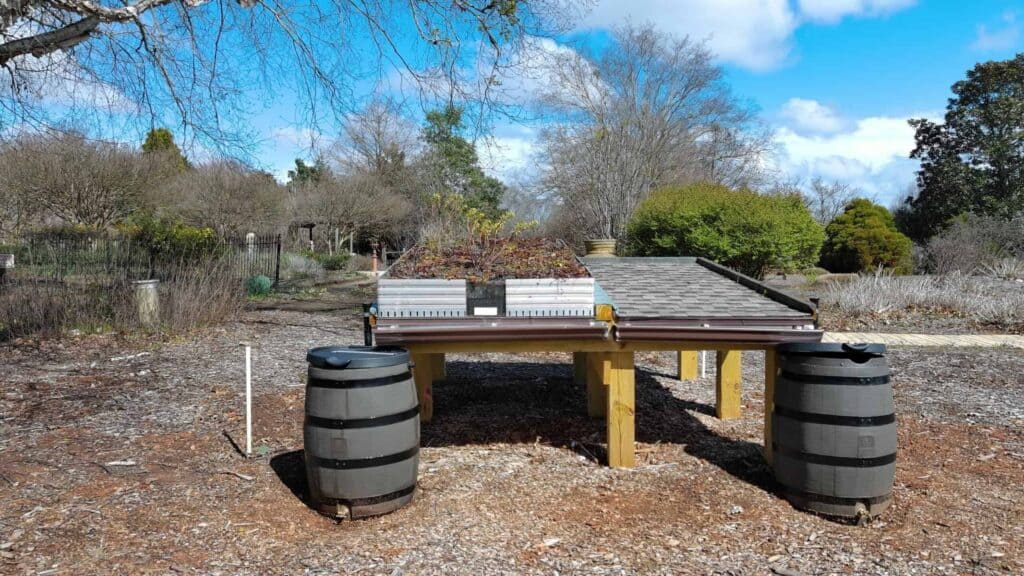
At the demonstration site, two 40-gallon rain barrels are positioned on concrete block bases to receive runoff from the green roof display table. A divided gutter directs water through downspouts to each barrel.
Key Components
- Inlet screen at the top to keep bugs, leaves, and debris out
- Overflow mechanism directing excess water away from the home
- Spigot positioned at least 3 inches above barrel bottom for filling watering cans or attaching a hose
- Stable, flat surface at least 3 inches off the ground
Design Specifications
Sizing Considerations
To estimate runoff volume: roof area (sq ft) × rainfall depth (inches) × 0.623 = gallons of runoff. A 200-square-foot section of roof receiving 1 inch of rain produces approximately 125 gallons of runoff, more than a single rain barrel can hold.
Installation
- Position on a level, stable surface (full 40-gal barrel weighs over 330 lbs)
- Direct overflow away from building foundations
- Install tight-fitting screen on all openings to prevent mosquito breeding
- Use only non-toxic, food-grade containers for edible plant irrigation
- Connect multiple barrels in series for increased capacity
Try It Yourself
Rain barrels are among the easiest stormwater practices for homeowners to install. Start with a single barrel on your highest-flow downspout. Elevate the barrel on cinder blocks for better water pressure. Use harvested rainwater on ornamental plantings, vegetable gardens, and container plants. Georgia generally allows residential rainwater collection. Consider pairing rain barrels with a rain garden (Stop 7) to handle overflow during heavy storms.
For Professionals
Rain barrels offer a low-cost entry point for client education on stormwater management. For larger commercial or institutional applications, cistern systems (Stop 8) provide significantly greater storage capacity. The Georgia Stormwater Management Manual addresses rainwater harvesting in Section 4.19 of Volume 2.
Resources
Download fact sheets, design guides, and technical resources for this practice.
-
Rain Barrel Setup Guide Coming Soon
-
Rainwater Harvesting Calculator Coming Soon
- Georgia Stormwater Management Manual